Most general contractors understand they’re responsible for safety on their jobsite. What many don’t fully grasp is the extent of that responsibility under OSHA’s Multi-Employer Citation Policy — and how exposed they are when a subcontractor’s worker gets hurt or when an OSHA inspector walks onto the site.
Here’s what the policy actually says, what it means for your day-to-day operations, and how to build the documentation that protects you.
The Basic Rule: You Can Be Cited for Your Subs’ Hazards
Under OSHA’s Multi-Employer Citation Policy (CPL 02-00-124), there are four roles an employer can play on a multi-employer worksite: creating employer, exposing employer, correcting employer, and controlling employer.
As a general contractor, you are almost always the controlling employer — the entity that has overall responsibility for site safety and the authority to direct or correct other employers’ work.
Under this classification, OSHA can cite you for hazardous conditions created by your subcontractors, even if none of your own employees were exposed to the hazard.
In fiscal year 2025, OSHA issued over 4,200 multi-employer citations. Controlling employers received 38% of them. The financial exposure is real: a single serious violation carries a penalty of up to $16,550. If OSHA finds a pattern of inadequate oversight — meaning they find the same kind of hazard across multiple subs or multiple inspections — violations can escalate to “willful” status at up to $165,514 each.
Beyond the direct penalty, a citation on your record affects bonding capacity, owner prequalification, and insurance premiums. The downstream cost of a single serious citation is almost always higher than the penalty itself.
The “Reasonable Diligence” Standard
The controlling employer’s obligation under the policy is not to guarantee that no hazard ever exists — that’s an impossible standard on a complex jobsite. The obligation is to exercise reasonable diligence to identify and address hazardous conditions.
OSHA evaluates reasonable diligence based on:
- Whether you had a system to detect hazardous conditions
- Whether you implemented that system
- Whether you took prompt corrective action when hazards were identified
This is where documentation becomes your defense. An inspector who finds a hazardous condition on your site will ask: what systems did you have to catch this? Did those systems work? What did you do when you found a problem?
If your answer is “we have a safety plan in the trailer” but you have no records of inspections, no records of toolbox talks, no records of corrective actions taken — you’re in a difficult position.
If your answer is supported by weekly safety inspection reports, documented subcontractor safety orientations, toolbox talk attendance logs, and a written record of every corrective action taken — you are in a fundamentally different position.
What Documentation You Actually Need
OSHA expects controlling employers to maintain specific documentation for subcontractor oversight. Here’s what that looks like in practice:
Site-specific safety orientations. Every subcontractor’s workers should receive a documented orientation before starting work. This doesn’t need to be elaborate — a one-page acknowledgment form signed by the worker, recording that they received your site rules, emergency procedures, and relevant hazard information, is sufficient. Keep a binder with these forms on site.
Documented safety communications. Emails, meeting minutes, or written notices where you’ve communicated safety requirements to subcontractor supervisors. If you told a sub’s foreman verbally that their housekeeping was unacceptable, that conversation should be in your daily report and followed up with a written notice.
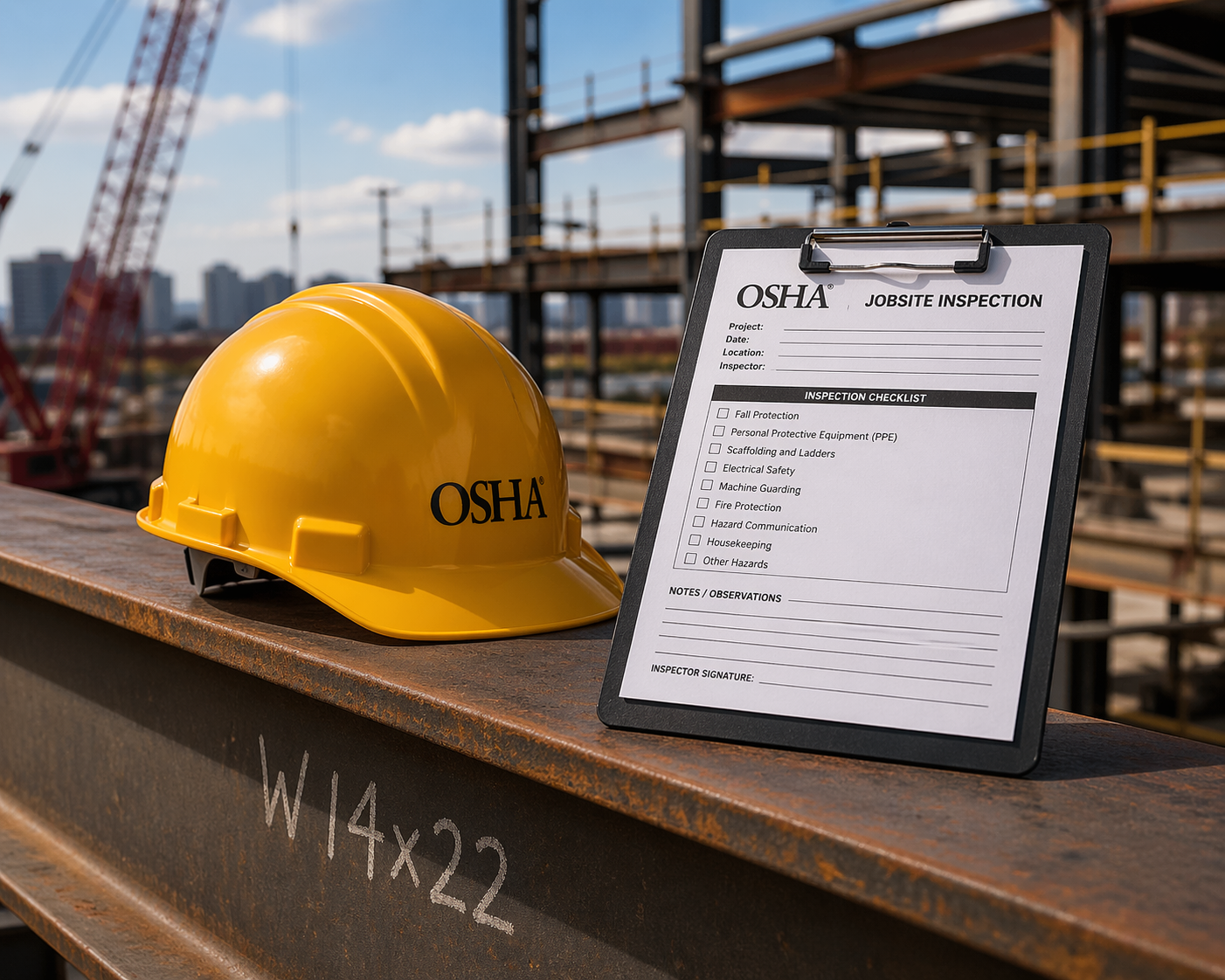
Inspection records. Regular documented site safety inspections — weekly at minimum on active projects. Record what you checked, what you found, and what action you took. A dated, signed inspection checklist is better than a narrative report.
Corrective action records. When you identify a hazard — whether in a formal inspection or during daily site walks — write it down. Note what the condition was, which subcontractor created it, how you notified them, and when it was corrected. This is your paper trail.
Toolbox talk logs. Date, topic, attendees. Simple as that.
Practical Steps to Reduce Your Exposure
Require safety plans from every sub before mobilization. A subcontractor’s site-specific safety plan is a basic requirement before they set foot on your site. Review it — actually read it — and confirm it addresses the specific hazards of their scope of work.
Verify certifications and insurance before work starts. Expired certifications are one of the most common OSHA findings on multi-employer sites. Forklift operators, crane operators, scaffold erectors — all require current certifications. Don’t rely on the sub to manage this. Build a system to verify and track.
Conduct and document weekly safety walks. Walk the site with a checklist. Document what you see. If you find a hazardous condition, issue a written notice to the responsible sub with a deadline for correction. Keep a copy.
Hold pre-task planning meetings for high-hazard work. Before any elevated work, confined space entry, trenching, or other high-hazard operations, hold a documented pre-task meeting with the responsible sub. Record who attended and what was discussed.
Put safety requirements in your subcontracts. Your subcontract should explicitly require compliance with your site safety plan, participation in orientations, and cooperation with inspections and corrective actions. When a sub creates a hazard and you can point to their contractual obligation to prevent it, you’ve strengthened your position significantly.
When OSHA Shows Up
Know what happens during an unannounced inspection so you’re not caught off guard.
The inspector will present credentials and explain the reason for the inspection — it could be a complaint, a referral from another agency, or a programmed inspection in a targeted industry.
You have the right to accompany the inspector during the walk-around. Exercise this right. It allows you to provide context, identify the scope of what they’re examining, and take notes.
Have your documentation organized and accessible. Safety plans, orientation records, inspection logs, toolbox talk attendance — if you have it organized, you demonstrate a functional safety management system. If you’re scrambling to find records during an inspection, that’s a bad signal.
Don’t speculate or volunteer information beyond what’s asked. Answer the inspector’s questions honestly, but don’t expand the scope of the inspection by offering information about areas or conditions they haven’t asked about.
After the walk-around, the inspector will typically conduct a closing conference where they discuss any apparent violations they observed. This is not the final citation — it’s the beginning of a process. You’ll have an opportunity to provide additional documentation and context before citations are issued.
The Bottom Line
The multi-employer citation policy means your safety exposure extends to every worker on your site, regardless of who employs them. The good news is that the standard you have to meet — reasonable diligence — is achievable with consistent documentation and a genuine safety management system.
The GCs who get hurt by OSHA enforcement are usually not the ones who had dangerous sites. They’re the ones who had no documentation to show that they took safety seriously.
Build the paper trail. It’s not just about compliance — it’s how you protect your business when something goes wrong.
Jobsite Blog covers safety and compliance from the GC’s perspective. This post is for informational purposes — consult with a safety professional or attorney for guidance specific to your projects.