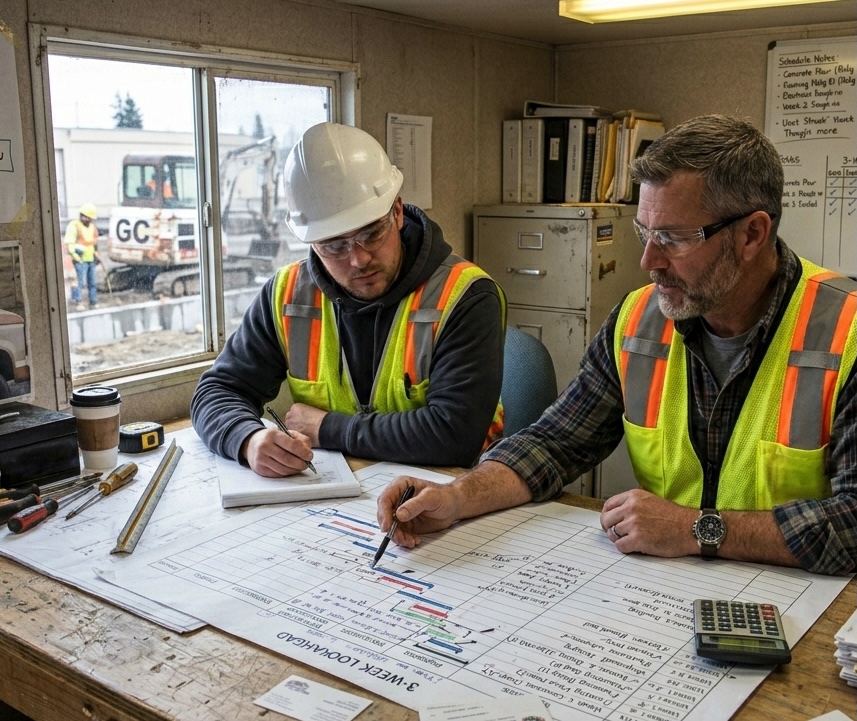
Walk into ten construction trailers and you’ll find ten 3-week lookahead schedules pinned to the wall. Eight of them are out of date. The other two are technically current but nobody on the crew has looked at them since the last weekly subcontractor meeting.
The 3-week lookahead is the most universally taught and the most universally underused tool in construction project management. It exists because somebody on every project knows it should exist. It fails because the process around it doesn’t surface what the lookahead is supposed to surface: real commitments, real conflicts, and real preconditions for next week’s work.
Here’s how to run a lookahead that actually drives the schedule.
What the Lookahead Is Actually For
The 3-week lookahead is not a derivative of the master schedule. It’s not a printout of the next 21 lines of your Primavera or Microsoft Project file. If that’s what you’re producing, you’re producing wallpaper.
The lookahead is a planning conversation, captured on paper, with three jobs:
- Confirm what’s about to start has the preconditions in place — drawings, materials, manpower, prior trade complete, inspections passed.
- Surface conflicts between trades that the master schedule is too coarse to show.
- Generate explicit commitments from each subcontractor about what they will and won’t have done by the end of each week.
If your lookahead document doesn’t do those three things, fix the process — not the document.
The Weekly Cadence
The lookahead works on a weekly cycle. There’s no flexibility on this. The cycle has four touchpoints:
Monday morning: site walk with the foremen. The superintendent walks the site with the active foremen — typically 30 to 45 minutes. The walk has one purpose: confirm what was committed for last week against what was actually accomplished, and identify what is ready to start this week. No discussion of next week, no planning sessions. Just verification.
Wednesday: lookahead update. The superintendent updates the lookahead document with the previous week’s actuals and the next three weeks of planned work. This update is informed by the Monday walk, the current master schedule status, and direct conversations with each sub’s foreman about what they realistically expect to accomplish.
Thursday: subcontractor coordination meeting. The superintendent leads a 60-to-90-minute meeting with the foremen of every active subcontractor. The lookahead is the agenda. Each line item gets confirmed or modified by the foreman responsible for it. Conflicts get surfaced and resolved in the room. New lookahead is finalized in the meeting.
Friday: distribution. The finalized lookahead is distributed by end of day Friday — to subcontractor foremen, project managers, the architect, and the owner if applicable. Distribution is electronic and the document goes on the trailer wall as the working reference for the following week.
If any of these four touchpoints regularly slips, the lookahead degrades to wallpaper within a month.
What Belongs on the Lookahead — and What Doesn’t
A useful lookahead has the right level of detail. Too coarse and it doesn’t surface conflicts. Too fine and the meeting takes three hours and nothing gets decided.
The right unit of work is roughly a half-day to two-day activity. “Frame walls — Level 3 north” is a useful lookahead line. “Frame walls — Levels 1-3” is too coarse. “Set top plate, gridline 4-7” is too fine.
Each line should have a responsible foreman, a target start, and a target finish. If the line is a continuation of work in progress, note the percent complete at the start of the week and the percent expected at the end.
Include the preconditions explicitly. What needs to be in place before each activity can start? Drawings issued? Material on site? Prior trade complete? Inspection passed? If you don’t list the preconditions on the lookahead, the lookahead can’t surface when one is missing.
Don’t include items that are months out. The lookahead is three weeks. Beyond that, you’re guessing — and committing subs to guesses degrades the credibility of the lookahead. If a long-lead item needs tracking, track it on a separate procurement log.
Don’t include items the GC controls but hasn’t committed to. If you put “complete RFI 047 response” on a lookahead and then don’t deliver it, you’ve taught your subs that the lookahead is aspirational.
How to Run the Coordination Meeting
The Thursday meeting is where the lookahead earns its keep or fails. The discipline of how you run that meeting is most of the difference between a useful lookahead and a useless one.
The superintendent runs the meeting. Not the project manager, not the assistant super, not a coordinator. The person responsible for executing the schedule runs the schedule meeting. If the super isn’t in the meeting, the meeting has the wrong leader.
Foremen attend, not project managers. The lookahead is about field execution. Project managers can be in the room as observers, but the foreman who is responsible for the work is the person who confirms the commitment. If the foreman isn’t there, that sub doesn’t get to commit and you note it on the lookahead.
Go line by line. For each line on the lookahead, ask the responsible foreman: are the preconditions in place, can you complete this in the timeframe shown, and what could prevent it? The answers go on the lookahead document directly.
When a precondition is missing, assign the action and the deadline. “Drawings for the south stair are not issued” is not actionable. “GC to issue revised drawings for south stair by Tuesday EOD, or this work moves out one week” is actionable. The lookahead captures the action and the deadline, and the action shows up on next week’s lookahead until it’s done.
Surface conflicts in the room. If two subs need the same area at the same time, that conflict has to be resolved in the meeting. If you defer it, the conflict will become a delay. The superintendent makes the call — using whatever information is available — and the decision goes on the lookahead.
End the meeting with a redistributed document. A decision made in the meeting that doesn’t appear on the updated lookahead by Friday morning is a decision nobody is bound to.
Why Most Lookaheads Fail
A few patterns kill lookaheads consistently.
The lookahead is generated from the master schedule by a project engineer. The project engineer pulls the next 21 days of activities from the schedule, formats them into a document, and circulates it. Nobody walked the site, nobody talked to the foremen, and nobody surfaced any conflicts. The document is technically a lookahead. It does none of the work a lookahead is supposed to do.
The Thursday meeting becomes a status update instead of a planning session. If the meeting consists of each sub reading off what they did last week, you’re not doing a lookahead — you’re doing minutes. The point of the meeting is to commit to next week, not to recap last week.
The lookahead doesn’t track preconditions. Without preconditions, the lookahead can’t catch a sub committing to start work on a wall that doesn’t have framing complete yet. The preconditions field is what turns the lookahead from a calendar into a planning tool.
The superintendent doesn’t enforce missed commitments. When a sub commits on the lookahead and doesn’t deliver, the failure has to be visible on the next lookahead. If commitments slide silently, the subs learn that the lookahead is fiction.
Distribution is inconsistent. A lookahead that goes out Friday one week, Monday the next, and not at all the third week is a process the subs will stop relying on. Pick a distribution time and hold it.
What a Working Lookahead Looks Like in Practice
When the lookahead is working, you’ll notice specific things on the project.
Conflicts get raised earlier. A sub recognizes in the Thursday meeting that next week’s drywall hang will conflict with mechanical that isn’t complete, and the conflict is resolved Friday instead of becoming Tuesday’s delay.
Material gets on site before the activity starts. Subs reference the lookahead for procurement timing — if drywall hang is on next week’s lookahead, the drywall delivery is scheduled for Saturday, not Tuesday afternoon when the crew is already on site.
Inspection requests go in earlier. The inspection lead time becomes part of the precondition tracking, and the calls to the inspector go in the day before the activity needs to start, not the morning of.
Subcontractors start showing up to coordination meetings prepared. Foremen come to Thursday meetings with their own subset of the lookahead marked up, ready to confirm or push back on commitments. That preparation is the strongest signal that the lookahead has earned credibility.
The Bottom Line
The 3-week lookahead is one of the highest-leverage tools in field management — when it’s run as a process and not produced as a document. The process is simple: weekly cadence, field-driven inputs, foreman-level commitments, conflicts resolved in the room, consistent distribution.
What separates the supers who run great projects from the ones who run troubled ones isn’t access to better software or more sophisticated scheduling techniques. It’s the discipline of running the lookahead like it matters.
Because it does.
Jobsite Blog covers field management from the superintendent’s perspective. If you have a specific scheduling challenge you’d like us to address, reach out through our contact page.