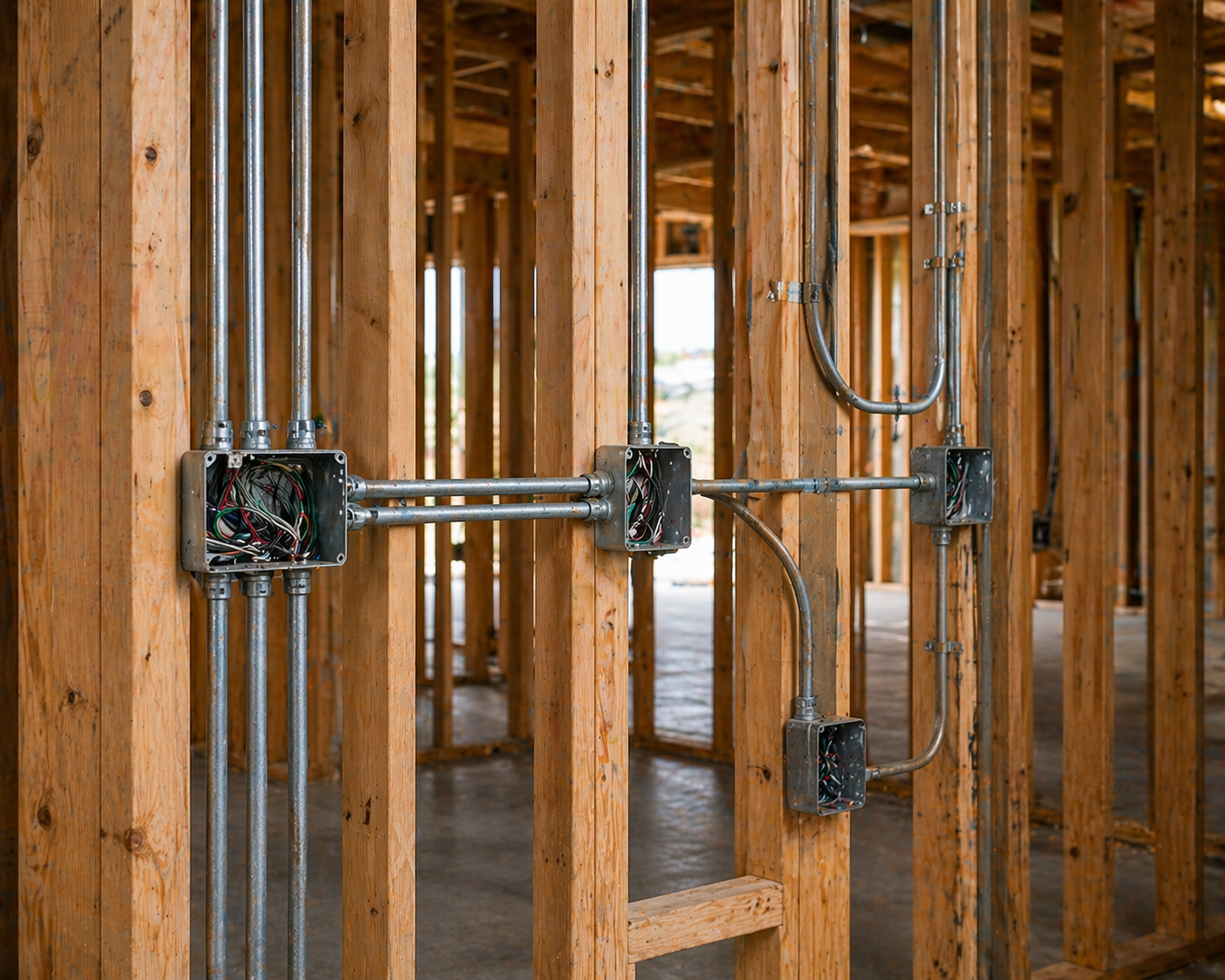
Once the drywall goes up, your options shrink dramatically. A missed rough-in — a junction box in the wrong location, a conduit run that conflicts with the HVAC duct, a panel that wasn’t roughed in for the load it needs to carry — goes from a two-hour fix to a multi-day demolition and repair that lands squarely in dispute territory.
Electrical rough-in is one of the highest-stakes coordination phases on any commercial or multi-family project. It’s where the conflicts between structural, MEP, and architectural drawings get resolved — or don’t. And it’s where the relationship between the GC and electrical subcontractor either works or breaks down.
This post is for both audiences: GCs who need to know what to expect and require from their electrical sub, and electrical contractors who want to understand what a well-run coordination process looks like from the GC’s perspective.
The Coordination Sequence That Prevents Rework
Electrical rough-in doesn’t happen in isolation. It happens in a specific sequence relative to other trades, and when that sequence breaks down — when electrical tries to run conduit before structural steel is complete, or before the HVAC duct layout is confirmed — conflicts compound.
A well-run coordination sequence looks like this:
Step 1: BIM or drawing coordination before anyone picks up a conduit. On any project where MEP systems are complex enough to create conflicts — and that’s most commercial projects over about 5,000 square feet — the electrical, mechanical, and plumbing subs should be coordinating their drawings before rough-in begins. This means reviewing the drawings together, identifying conflicts, and resolving them on paper. It’s not glamorous work, but finding a conflict in a drawing review is a 30-minute fix. Finding it when the conduit is already installed is a day of rework.
Step 2: Confirm structural penetrations. Every conduit run that needs to pass through a rated wall, a structural beam, or a concrete slab needs to be coordinated with the structural engineer before the penetration happens. Electrical contractors sometimes treat this as a field decision — “we’ll core drill when we need to.” That approach creates structural liability, coordination failures with the fire-stopping sub, and rework when the penetration location conflicts with rebar or post-tension cables. Penetrations need to be coordinated and approved before they’re made.
Step 3: Confirm device locations against architectural and interior design. Outlet locations, switch locations, and panel locations need to be confirmed against the latest architectural drawings before boxes are set. On projects with interior designers or a detailed FF&E plan, furniture layouts affect where devices can be located. Finding out that the electrical panel is directly behind the millwork the owner selected is a conversation nobody wants to have after rough-in is complete.
Step 4: Confirm load calculations before panel rough-in. This is especially important on tenant improvement and retrofit projects. Before the electrical sub roughs in a new panel or extends an existing one, confirm that the load calculations support the intended use. A panel roughed in for one load that ends up serving significantly more is a problem that doesn’t reveal itself until the building commissioner or the tenant’s electrician runs into it.
What the GC Should Be Verifying During Electrical Rough-In
As the GC, you’re not responsible for the technical execution of the electrical rough-in — that’s the electrical sub’s expertise. You are responsible for confirming that the work is happening in coordination with the other trades, in the right sequence, and with adequate documentation.
Specific things to verify and document during rough-in:
Rough-in locations match the drawings. Walk the rough-in with the drawings in hand before drywall is scheduled. Box locations, panel rough-ins, and conduit stub-outs should be verifiable against the electrical plans. If there are field adjustments — and there always are — they should be documented in a field sketch or RFI, not left as undocumented deviations.
Penetrations through rated assemblies are documented. Every penetration through a fire-rated wall, floor, or ceiling assembly needs to be documented before it’s made — and fire-stopped according to a listed assembly after it’s made. The fire-stopping sub needs a list of all penetrations to do their work correctly. If penetrations are being made without documentation, the fire-stopping scope becomes undefined and the GC has a real liability issue.
Clearances are maintained around electrical equipment. Code-required clearances around panels, switchgear, and other electrical equipment need to be confirmed before adjacent trades install their work. A panel that ends up with less than the required working clearance because the adjacent framing or mechanical equipment encroached on the space is a failed inspection and a real headache.
Wire pulls haven’t happened where conditions aren’t ready. Wire pulls through conduit in areas that are still active construction — areas where concrete work, waterproofing, or other wet work is ongoing — create damage and contamination risks. Coordinate with the electrical sub on the phasing of wire pulls relative to other construction activities.
Common Electrical Rough-In Failures and How to Prevent Them
Missing or mislocated boxes discovered at finish. The electrical sub roughed in boxes per the drawings, but the drawings were superseded by an architectural revision that moved the devices. The fix requires opening drywall, relocating the box, and patching — plus a conversation about who pays.
Prevention: confirm that the electrical sub is working from the current drawing revision. Build a drawing distribution log into your project management process that tracks which version of each drawing is current and when it was issued to each sub.
Conduit conflicts with mechanical ductwork. The electrical conduit was run through a space that the HVAC duct layout also needs. Both subs had drawings that appeared to show the space available. Neither checked with the other.
Prevention: require a joint coordination review between the electrical and mechanical subs before rough-in begins in any area with significant MEP density — mechanical rooms, corridors, areas below the structural deck with limited plenum height. This doesn’t need to be formal BIM coordination on every project; it can be a 30-minute conversation with the two foremen and the relevant drawing set.
Panel location conflicts with building use. The electrical panel was roughed in per the electrical drawings, but the building layout evolved and the panel ended up in a location that doesn’t work — inside a closet that became an accessible bathroom, behind a wall that’s now glass, or in a location that the owner’s facility team can’t access without going through a tenant space.
Prevention: confirm panel locations with the owner’s facility management representative before rough-in. This is especially important on tenant improvement projects where the tenant may have specific requirements about equipment access.
Insufficient rough-in for technology systems. The electrical rough-in was completed based on the electrical drawings, but the low-voltage and AV systems — which are often on separate drawings or even separate contracts — needed additional conduit, boxes, or sleeve locations that weren’t coordinated.
Prevention: confirm that the electrical sub has reviewed the low-voltage and AV drawings as part of their coordination scope, or that the GC has specifically coordinated the interface between the electrical rough-in and the technology systems.
Documentation That Protects Everyone
Whether you’re the GC or the electrical sub, the documentation around rough-in is what protects you when something doesn’t go right.
The electrical sub should be maintaining a daily log of work completed — specific locations, conduit runs made, boxes set, wire pulls completed. This provides the basis for schedule tracking and supports any productivity claim if the rough-in phase runs into coordination-related delays.
The GC should be documenting every coordination meeting, every field decision, and every deviation from the drawings with a dated record — whether that’s a daily report entry, an RFI, or a field sketch. When a rough-in issue surfaces at inspection or at finish, having a clear timeline of when decisions were made and who made them is worth far more than trying to reconstruct events months later.
The Bottom Line
Electrical rough-in is one of those phases where an hour of coordination effort before work starts is worth a day of rework after. The conflicts are predictable — structural penetrations, MEP coordination, device location verification — and the prevention is straightforward if the process is in place.
GCs who run tight rough-in coordination don’t have less conflict than those who don’t. They just find the conflicts earlier, when they’re cheap.
Jobsite covers specialty trade coordination from both the GC and subcontractor perspective. If you have a specific coordination challenge in your trade, reach out.